Purpose and Functionality
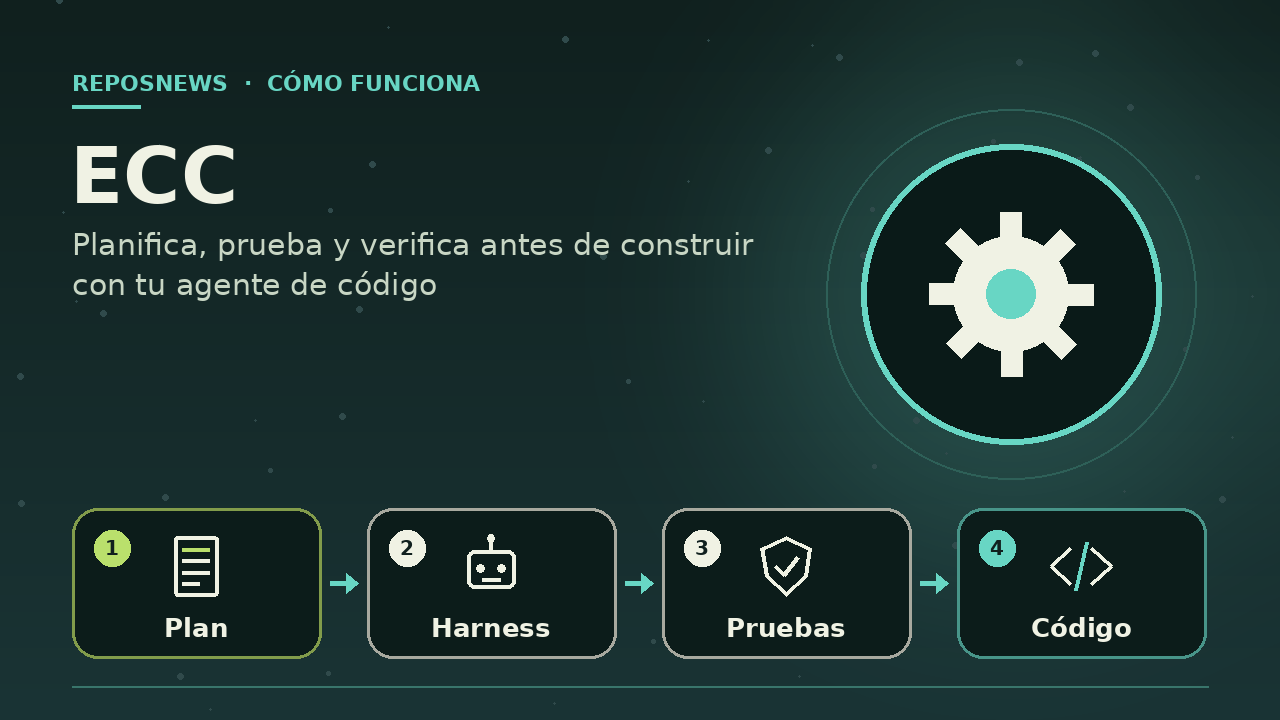
ECC (The agent harness performance optimization system) provides your AI agent with a coordinated engineering system and toolbox. It empowers the model to plan before building, verify changes with automated tests, review its own work from a fresh context, remember what matters, and turn repeated wins into reusable skills and workflows. Instead of rebuilding this process in every prompt, ECC installs once to become part of how your agent operates.
Requirements
The universal package requires Node.js 18 or newer. Claude plugin setup additionally requires Git and Claude Code 2.1 or newer available on the system `PATH`.
Installation
The recommended path for universal guided setup is:
npx ecc-universal@2.2.3 setupTo configure multiple coding agents in a single reviewed flow:
npx ecc-universal@2.2.3 install --guidedFor a low-context installation without the runtime hook engine:
npx ecc-universal@2.2.3 install --profile minimal --target claudeUsage
ECC relies primarily on workflows and skills, complemented by specialized agents and commands:
- Building features: `/ecc:plan "describe feature"`, followed by test-driven development workflows.
- Fixing bugs: Reproduce with a failing test, then execute test-driven workflows.
- Code review: `/code-review` for fresh-context evaluations.
- Security scanning: `/security-scan` or utilizing built-in AgentShield protection.
Advantages and Limitations
Advantages:
- Optimizes the agent context window by structuring memory, skills, and agents.
- Multi-harness compatibility covering Claude Code, Codex, Kimi Code, Cursor, and others.
- Includes extensive pre-built roles for architecture, planning, building, and security.
Limitations:
- Feature parity varies across platforms according to the supported adapter matrix.
- Advanced workflows like `multi-*` commands require configuring external runtimes such as `ccg-workflow` independently.
Alternatives and Editorial Comparison
Compared to manual system prompts or isolated helper scripts, ECC acts as a comprehensive engineering operating system for AI agents. Rather than ad-hoc configurations, it standardizes planning, testing, and continuous learning into automated hooks and structured skill execution.
License and Official Pricing
ECC is open source and licensed under the **MIT** license forever.
*Official pricing:* Verified pricing indicates that the core open-source project remains free. ECC Pro, the hosted GitHub App designed for private repositories, is available starting from $19 per seat per month. Please check official sources for current pricing structures.
Official Links
- GitHub Repository: [github.com/affaan-m/ECC](https://github.com/affaan-m/ECC)
- Project Website: [ecc.tools](https://ecc.tools)
- Universal npm Package: [ecc-universal](https://www.npmjs.com/package/ecc-universal)
- AgentShield npm Package: [ecc-agentshield](https://www.npmjs.com/package/ecc-agentshield)
What the Reel shows
Screenshots of the official ecc.tools web interface and repository statistics on GitHub showcasing the AI skills and agent ecosystem.
The system unifies hundreds of capabilities for coding agents into a single integrated platform.
Reel claims are distinguished from facts checked against the official article sources.
Sources and methodology
Official sources checked on the stated date. We do not claim growth without historical data or installations that have not been run.
https://github.com/affaan-m/ECC